
An artistic investigation into perception, memory, and living systems.
What do we actually know about another living being from what we can see?
This question is at the center of What Remains Unseen, an evolving body of work developed through watercolor, drawing, and mixed media.
The project began with close observation of animals and natural forms. Their gestures, movements, textures, and distinctive characteristics offered an immediate visual starting point. Yet, as the work developed, representation alone became insufficient.
A recognizable body can reveal appearance, but not the complete experience of being alive. Relationships, memory, behavior, environmental conditions, and biological processes remain partially hidden.
This tension between visibility and understanding gradually transformed my approach to image-making.
Instead of treating the subject as an isolated figure, I began to consider the surrounding environment, the relationships between organisms, and the ways in which natural systems leave visible traces.
Watercolor plays a fundamental role in this process.
Each painting develops through a sequence of decisions and material responses. Water moves pigment across the surface. Transparent washes preserve earlier marks. Color accumulates in some areas and disappears into others. The resulting image records both intentional gestures and events that cannot be completely controlled.
This relationship between control and uncertainty mirrors the questions explored in the work itself.
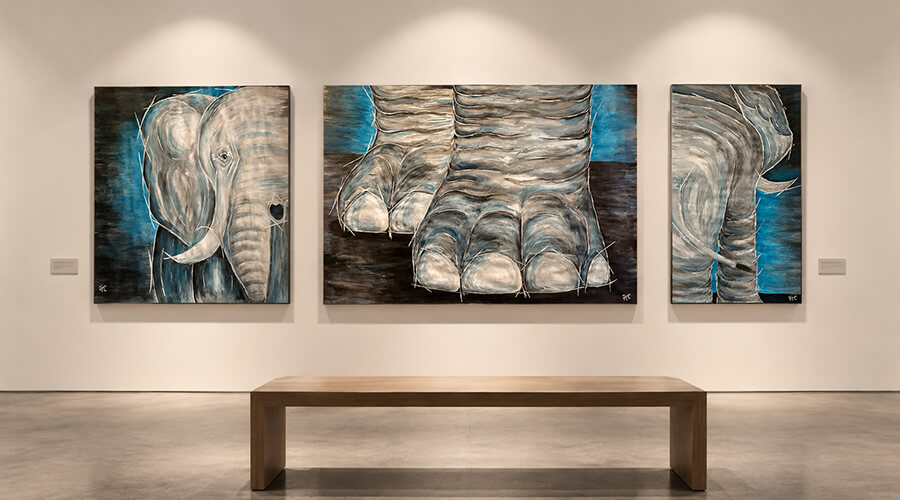
Digital exhibition visualization.
My practice is informed by sustained observation, visual research, and an interest in how images shape our understanding of living subjects. Working from Costa Rica, where ecological diversity is part of the surrounding environment, I approach nature not simply as a source of imagery but as an invitation to question how we perceive interconnected forms of life.
What Remains Unseen continues to expand from individual portraits toward broader investigations of aquatic environments, animal relationships, botanical structures, landscape, and memory.
The objective is not to provide a complete explanation of these systems, but to create images that invite viewers to look longer, question familiar representations, and recognize the limits of what can be seen.
Looking Beyond the Visible
Observation is only the beginning.
A sea turtle moving through water. The transparency of a jellyfish. The proximity of two animals. The changing rhythm of a landscape.
Each image begins with a recognizable subject, but the subject is never the entire story.
Behind every visible form are relationships, memories, biological processes, and environmental conditions that cannot be fully represented through appearance alone.
My work explores this distance between seeing and understanding.
Watercolor becomes an essential part of the investigation. Pigment travels through water, settles into paper, overlaps previous marks, and sometimes moves beyond the artist’s control. The process creates an image shaped by both intention and unpredictability.
These material behaviors are not simply visual effects. They are part of how the work thinks about living systems.
From Inquiry to Artwork
The ideas explored in What Remains Unseen take different forms across aquatic studies, animal portraits, botanical structures, and landscapes.
Each artwork offers a distinct encounter with the visible world while inviting further questions about what lies beyond representation.